
The Spectrum of Resilience, the Untold Story
Curated by Mary Salvante, Director, Rowan University Art Museum
Jazlyne Sabree’s solo exhibition, The Spectrum of Resilience, at the Rowan University Museum of Contemporary Art, Glasboro, New Jersey, unites the intimacy of care, daily life, and cultural inheritance through large-scale, vibrant collaged paintings. While Sabree’s exhibition statements focus primarily on genealogy and African diasporic history, in public conversations she has also discussed how living with lupus informs her artistic practice. As an interdisciplinary artist who also lives with an invisible disability, I approach Sabree’s work through disability not simply as identity but as a creative methodology. Viewed through this lens, The Spectrum of Resilience becomes not only an exploration of ancestry but also an affirmation of interdependence, where care, rest, and adaptation emerge as creative acts.
In her exhibition statement, Sabree cites sources including Archaeology of the African Diaspora (edited by Akinwumi Ogundiran and Toyin Falola) and Cultural Resilience and Filial Responsibility Among the African Diaspora: To Be or To Belong,1 alongside her own genealogical research into African ancestry. However, her own knowledge of lived experience is not highlighted even though it is evident in her work. I argue that disability functions not as a limitation but as a creative methodology of practice that deepens Sabree’s attentiveness to care, vulnerability, and adaptation. As Stephanie Heit observes in her essay, “Disability as a Creative Practice,” “This attunement means that my art practice doesn’t stay the same and often has an unpredictable timeline and production schedule.”2
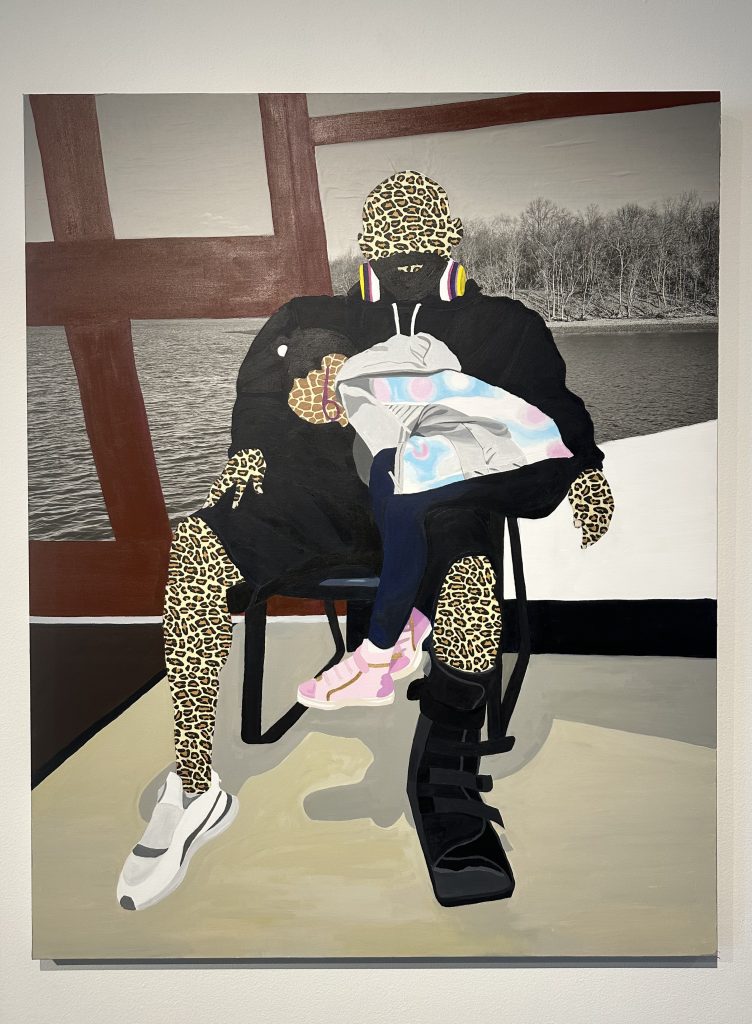
Rather than presenting illness as spectacle, Sabree frames support as an everyday practice embedded within family, domestic space, and cultural memory. Each collaged portrait painting uses animal hide patterns instead of human skin. This change provides a layer of protection, anonymity, and a way to reverse the gaze. The hides simultaneously invoke West African spiritual traditions while disrupting conventional portraiture, transforming the body into a site where ancestry, protection, and vulnerability coexist. The collaged mix of media including acrylic, paper, vellum photograph, and glass tells a narrative beyond the scene portrayed. Like the collaged surfaces themselves, identity emerges as something layered, assembled, and continually reshaped rather than fixed.
Black-and-white landscape imagery recedes into the background, linking ancestral histories with the present while situating the figures within a broader environmental and historical continuum.
In Sabree’s self-portrait, Between Drips and Dignity (2026), she shares her hospital experience during a lupus flare-up. Through genealogical research, Sabree came to understand that lupus and other autoimmune conditions also affected women in her family.3 Sabree depicts herself with one foot extending beyond the bed, suggesting movement toward recovery. The bed is emblazoned in gold like a throne. The prominent gold, heart-shaped earring and carefully arranged hair reinforce that she is more than a patient. Sabree’s genealogical research reveals inheritance not only as cultural memory but also as embodied history, where ancestry encompasses both resilience and chronic illness.
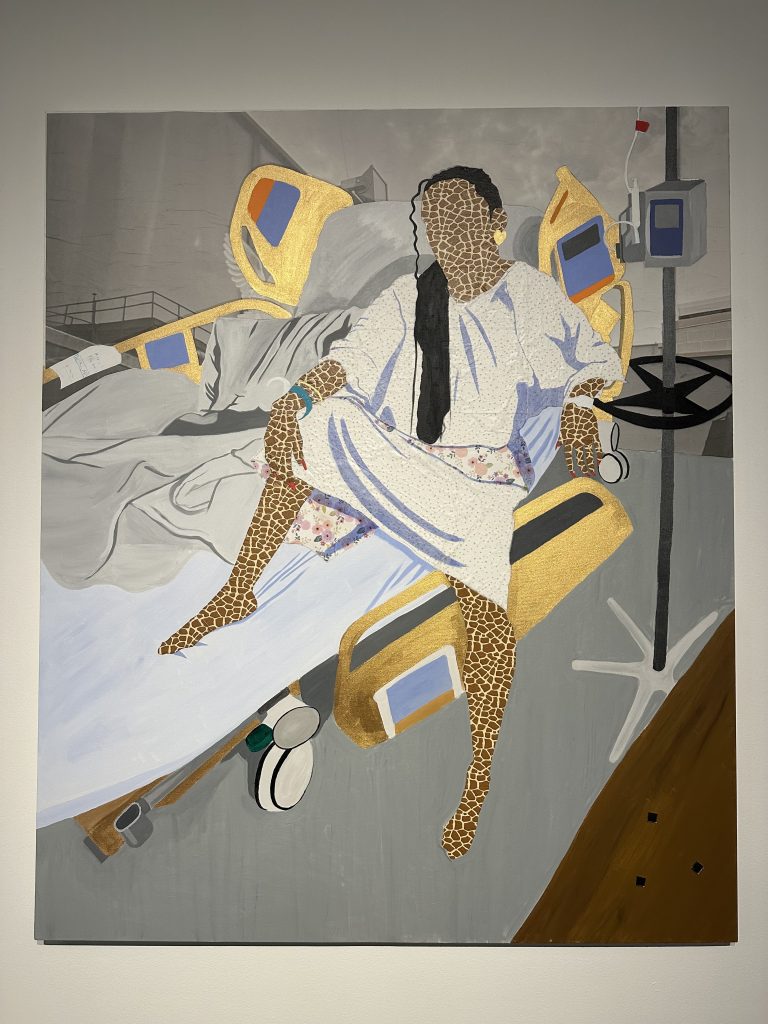
In Patient Recovery: Evidence of Survival (2026), the title refers to a process of healing. The figure’s arms are bandaged from previous IV puncture wounds, yet her hands are adorned with bright red nail polish and rings, affirming an identity that extends beyond the role of patient. She leans forward as if preparing to rise, conveying determination despite physical vulnerability. A small square mirror implicates viewers in the shared experience of vulnerability and interdependence.
Life Raft (2024) and Rest is a Side Effect for Love (2024) testify to the generative potential of rest. In the former, the majestic bed, emphasized by the large silver headboard, stands out against a sea of blue sheets. The three sprawled figures which Sabree identifies as herself and two children,4 seem to sink into bed with exhaustion but are kept afloat by the sturdiness of the bed. In the latter painting, the person reclines on a soft chocolate brown couch that fills the frame, but appears to be pulled in two directions as the feet dangle towards the floor. An iPhone and headphones sit within reach yet remain untouched, suggesting a deliberate withdrawal into rest rather than distraction. A handwritten poem titled Zig Zag Road extends the painting’s meditation on endurance and balancing life’s emotions.
The resilience and love evident in Always Sleep in Paw Paw’s Lap (2025) recalls the concept of creative tendings described in the essay “Creative Tendings as Self-Care,”5 which defines care as an ongoing practice of sustaining oneself and others. Paw Paw’s steady presence, despite his own injured leg, embodies reciprocal attentiveness rather than one-sided caregiving. Acts of tending become the language through which love is expressed, shared, and sustained. Sabree ultimately invites viewers to understand resilience not as independence but as interdependence—a practice of rest, recovery, and collective flourishing. Sabree’s work affirms disability not only as lived experience but also as a source of artistic knowledge and creative possibility.
Notes
- Obodoegbulam Agi Otto (Ph.D.), Tasie Henry Onyedikachi, and Stephen Egwuatu Amadi, “Cultural Resilience and Filial Responsibility Among the African Diaspora: To Be or To Belong,” Journal of African Studies and Sustainable Development (JASSD), Volume 5, Number 3, 2022.
- Stephanie Heit, “Disability as a Creative Practice,” Mad in America, March 17, 2023.
- Jazlyne Sabree, artist talk, Rowan University Museum of Contemporary Art, April 8, 2026.
- Ibid.
- Stephanie Heit and Petra Kuppers, “Creative Tendings as Self-Care, ” CSPA (Centre for Sustainable Practice in the Arts) Quarterly No. 18, Fall 2017, dis/sustain/ability.
Read other reviews in this issue of Wordgathering.
Back to Top of Page | Back to Art | Back to Volume 20, Issue 1 – Summer 2026
About Chanika Svetvilas
Chanika Svetvilas is an interdisciplinary artist and has written art reviews for The Amp, an online magazine. For more information about her work, visit chanikasvetvilas.com or follow her on Instagram @Chanika Svetvilas.