
Queer Crip Love
with photos of and by Louraine Apostol and Moon Kim
Editor’s Note: This content is best accessed using a desktop computer.
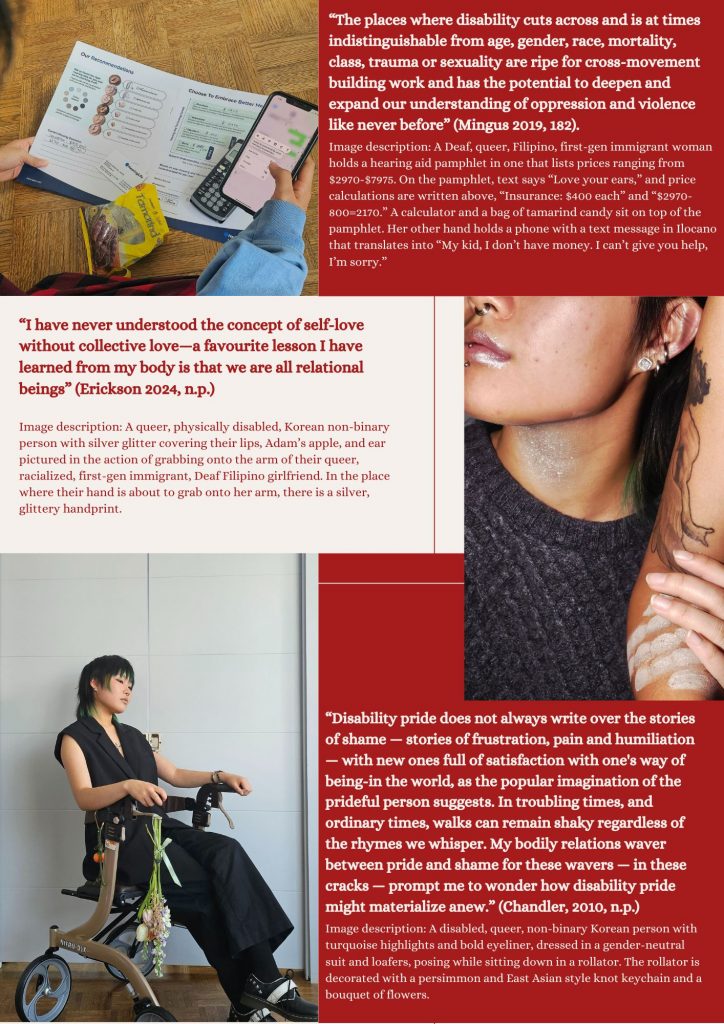
Quotes and Image Descriptions
- Top right, white text on a red background: “The places where disability cuts across and is at times indistinguishable from age, gender, race, mortality, class, trauma or sexuality are ripe for cross-movement building work and has the potential to deepen and expand our understanding of oppression and violence like never before” (Mingus, 2019, p.182). Image description: A Deaf, queer, Filipino, first-gen immigrant woman holds a hearing aid pamphlet in one that lists prices ranging from $2970-$7975. On the pamphlet, text says “Love your ears,” and price calculations are written above, “Insurance: $400 each” and “$2970-800=$2170.” A calculator and a bag of tamarind candy sit on top of the pamphlet. Her other hand holds a phone with a text message in Ilocano that translates into “My kid, I don’t have money. I can’t give you help, I’m sorry.”
- Middle left, red text on a gray background: “I have never understood the concept of self-love without collective love—a favourite lesson I have learned from my body is that we are all relational beings” (Erickson, 2024, n.p.) Image description: A queer, physically disabled, Korean non-binary person with silver glitter covering their lips, Adam’s apple, and ear pictured in the action of grabbing onto the arm of their queer, racialized, first-gen immigrant, Deaf Filipino girlfriend. In the place where their hand is about to grab onto her arm, there is a silver, glittery handprint.
- Bottom right, white text on a red background: “Disability pride does not always write over the stories of shame — stories of frustration, pain and humiliation — with new ones full of satisfaction with one’s way of being-in the world, as the popular imagination of the prideful person suggests. In troubling times, and ordinary times, walks can remain shaky regardless of the rhymes we whisper. My bodily relations waver between pride and shame for these wavers — in these cracks — prompt me to wonder how disability pride might materialize anew.” (Chandler, 2010, n.p.) Image description: A disabled, queer, non-binary Korean person with turquoise highlights and bold eyeliner, dressed in a gender-neutral suit and loafers, posing while sitting down in a rollator. The rollator is decorated with a persimmon and East Asian style knot keychain and a bouquet of flowers.
Artist Statement:
This triptych project, Queer Crip Love, explores how my partner and I navigate the interlocking oppressive forces of ableism, classism, racism, colonialism, and cis-heteropatriarchy through Queer Crip Love. I define Queer Crip Love as a resistant and relational practice of love and care for one’s own and other’s inherent differences and changing needs, grounded in learning from each other, embracing interdependence, and loving our sites of shame. Inspired by Alison Kafer’s (2013, pp. 15-17) coalitional approach to her work, Feminist, Queer, Crip, I draw from feminism’s commitment to praxis, and weave Queer and Crip theory together for their generative potential, their love for the fluidity of our shifting identities and needs, and for their capacity to hold our contradictory relationships with our bodyminds. Love exists in every aspect of Queer and Crip frameworks, because for us, survival necessarily involves loving our identities, our sites of shame, our differences, our needs, our interdependence, and each other. Queer Crip Love, therefore, provides a way to counter the violent material, structural, and emotional effects of interlocking oppressions, by transforming them into potent sites of learning, care, and pride. This project traces practices of Queer Crip Love through intimate fragments of our lives, centering the core themes of learning from interlocking oppressions, solidarity through care based interdependence, and resistant practices of pride.
Queer Crip Love begins by loving and learning from our intersectional lives. It starts by recognizing that we are all intersectional beings whose lived experiences overflow discrete identity categories. Those who occupy multiple marginalized intersections experience the most systemic violence, and as Mingus (2019, p. 182) reveals in “Radical Disability Politics,” these sites hold the potential to enrich our understanding of oppression and for cross-movement solidarity. One form of systemic violence that impacts multiply marginalized folks emerges from dominant single-issue frameworks that render the multiplicative effects of interlocking oppressions illegible. Queer Crip Love counters this violence because to love one another’s complex entirety is to learn from each other’s stories and refuse the violent erasure of our experiential knowledge.
My partner’s stories have taught me about how first-generation immigration from the Global South, disability, poverty, and gender interact in multiplicative ways to shape her life chances. Her deafness resulted from the interlocking and multiplicative forces of poverty, her gender, familial separation due to labor migration, and unsafe conditions in the Philippines. Now in Canada, poverty intertwines with race and the exploitation of her family’s immigrant labor to deny her access to hearing aids, as depicted in the first photograph. Our relational storytelling and learning are practices of resistant solidarity, made possible by, and an expression of, our Queer Crip Love.
Queer Crip Love understands that everyone has care needs, and because of our potent love for one another, it is our collective responsibility to meet them. Our inherent differences shape our changing needs, and the collective work to meet them is a relational act of solidarity and love that refuses the hierarchy of human worth. As Loree Erickson (2024, n.p.) reveals in “Bathing in Femmegimp Joy,” as relational beings, self-love cannot exist without collective love; by loving each other, we learn to love ourselves. She flaunts her sites of shame, her asymmetrical curves, her “power(ful) wheelchair” and non-normative care needs through queercrip porn, posing in a bath while covered in glitter (Erickson, 2024, n.p.). Her project, made possible by her care collective, teaches us that our capacity to thrive, especially as disabled folks with non-normative needs, relies on collective care and embracing our interdependence.
In my second photograph, inspired by Erickson’s glittery depiction of care (2024), my partner and my interdependence are written on each other’s bodies with silver glitter. Like glitter shifts, our interdependence constantly shimmers into new patterns as our needs change. With my hand on her arm, I walk, and with my voice in her ear, she listens. The artistic choice to embellish our interdependence, not our disabilities, critiques oppressive notions of disability as an individual problem, centering our interdependence that allows us to thrive and love ourselves.
Queer Crip Love gently holds our contradicting relationships with our bodyminds. As a visibly disabled person who started using mobility aids more recently, my rollator has become a simultaneous site of pride and shame. I love how it is decorated, how it helps manage pain, and grants me access to spaces where chairs are unavailable. At the same time, using my rollator instead of my cane subjects me to heightened access barriers and ableist remarks. As Eliza Chandler (2010) captures in “Sidewalk Stories: The Troubling Task of Identification,” “[d]isability pride does not always write over the stories of shame” (n.p.). We are not immune to internalizing shame when our world is filled with constant reminders that it is not designed for us.
Yet, shame does not exist in opposition to our pride and joy. Despite my progressive disability being at its worst, I have never been happier or loved my body more. In my final photograph, I flaunt my sites of shame: my disabled body and my rollator, decorated with my favourite keychain and a beautiful bouquet of flowers. My resistant Queer Crip Love for my disability does not write over my shame, but gently caresses it, intertwining itself into a resilient whole. As Chandler (2010) suggests, sitting with these contradictions creates loving sites of resistance where “pride rubs shame, pride comforts shame” (n.p.), transforming the liminal site into a generative space where pride can stick with us in our most difficult moments.
The process of putting together my triptych has been a magnificent practice of Queer Crip Love for both myself and my partner (Mingus, 2011). As relational beings, our collective love is our greatest strength. We love each other and ourselves for all our differences, so we tell our stories and we learn. We care for one another, so we embrace our interdependence to meet each other’s needs. We lovingly acknowledge the complexity of our lives, so we gently hold each other’s shame, while making room for our pride. When collective love comes first, the path to forging a world where we can all thrive becomes glitteringly clear.
References
Brown, Lydia X. Z., Loree Erickson, Rachel da Silva Gorman, Talila A. Lewis, Lateef McLeod, and Mia Mingus. 2019. “Radical Disability Politics.” In Routledge Handbook of Radical Politics, edited by A.J. Withers and Liat Ben-Moshe, 178–93. Routledge. https://doi.org/10.4324/9781315619880-15
Chandler, Eliza. 2010. “Sidewalk Stories: The Troubling Task of Identification.” Disability Studies Quarterly 30(3/4). https://doi.org/10.18061/dsq.v30i3/4.1293.
Erickson, Loree. 2024. “Bathing in Femmegimp Joy.” Feral Feminisms — Special Topic: Excess: Mad Queer Femme Abundance 14(1). https://feralfeminisms.com/wp-content/uploads/2024/08/03-FF-ISSUE14.1-Erickson.pdf.
Mingus, Mia. 2011. Moving toward the Ugly: A Politic beyond Desirability. Presented at the Femmes of Color Symposium Keynote Speech. https://leavingevidence.wordpress.com/2011/08/22/moving-toward-the-ugly-a-politic-beyond-desirability/.
Find more imagery in the Art section in this issue of Wordgathering.
Back to Top of Page | Back to Manifestos | Back to Volume 20, Issue 1 – Summer 2026
About the Author
Moon Kim (they/them) is a Korean, nonbinary, cripqueer artist, activist, and undergraduate university student based in Tkaronto. Completing a double major in psychology and critical studies of equity and solidarity, they are academically and artistically passionate about disability justice. They love creating forms of queercrip art, singing, connecting with the more-than-human world with their dog, and cooking.