
Editor’s Note: Underlined content is hyperlinked (each underlined element is a clickable link), leading to further aspects of the content shared, here. (This convention is consistent, throughout Wordgathering.)
In Japanese mythology, there is a god called Hiruko. He was the firstborn child of Izanagi and Izanami—the divine couple who created the Japanese islands. Hiruko was born without bones. Or without limbs. Or malformed in some unspecified way, depending on which ancient text you read. The details are vague, but the parents’ response was not: they put him in a reed boat and pushed him out to sea.
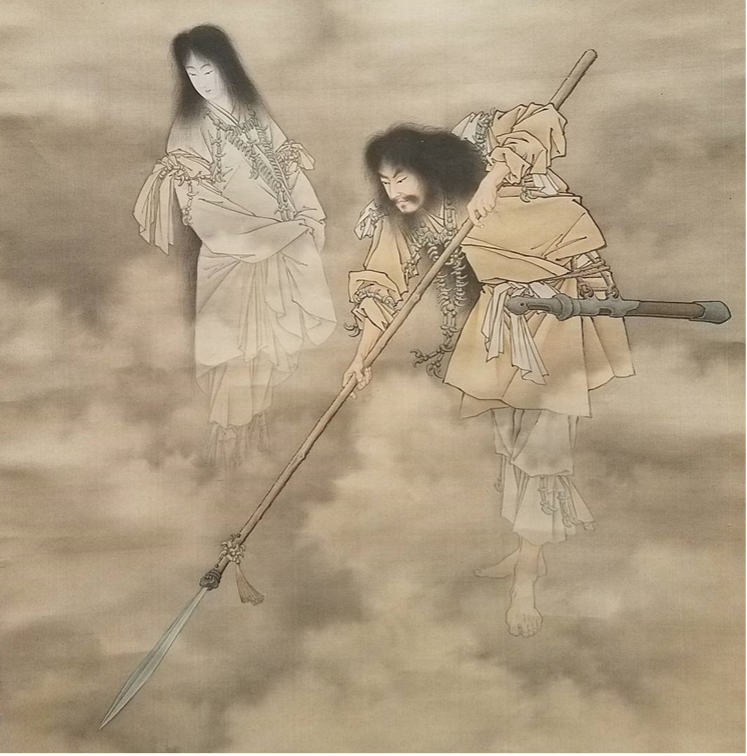
Image Description (English): A Japanese ink and color painting on silk, rendered in muted earth tones and soft gray washes. Two figures emerge from swirling mist. In the foreground, a muscular male figure (Izanagi) strides forward wearing a loose robe, gripping a long spear — the Ame-no-nuhoko — with which he and Izanami stirred the primordial ocean to create the Japanese islands. His hair is dark and wild, and his expression is stern and resolute. Behind him to the left, a female figure (Izanami) appears partially veiled by clouds, her face pale and composed, her layered robes flowing into the mist. Their expressions carry no visible tenderness or grief. These are the divine parents who, in the Nihon Shoki, deemed their firstborn child Hiruko imperfect and set him adrift in a reed boat on the sea.
That’s how the oldest surviving Japanese texts describe what happened to the first child of the gods. No funeral. No mourning. Just a boat made of reeds and an ocean that doesn’t care.
My son loves this story.
Let me say that again, because I need you to sit with it the way I had to: my son, who has a disability, read through the Nihon Shoki—one of Japan’s oldest historical chronicles—and the story he connected with, the character he saw himself in, was the baby his parents threw into the sea for being imperfect.
There is no parenting book that prepares you for this moment. There is no chapter titled “What To Do When Your Child Identifies With A Discarded God.” I checked.
I am a welfare journalist in Japan. I have spent years writing about disability, caregiving, dementia, and the ways society quietly sorts people into “useful” and “other.” I have interviewed hundreds of people on the margins. I have written about systems that fail them with the efficiency of a well-oiled machine. I thought I understood something about disability and identity.
Then my own kid looked at an ancient myth and said, “That’s me.”
And I realized I didn’t understand anything at all.
Here’s what makes the Hiruko story strange, though—and what I think my son already understood before I did.
Hiruko doesn’t die.
In later folklore, Hiruko washes ashore and is taken in by a fisherman. He grows up. He becomes Ebisu—the god of fishermen, luck, and prosperity. One of the Seven Lucky Gods of Japan. You’ve probably seen him on the label of a popular Japanese beer, grinning and holding a giant fish. He is everywhere in Japan: in shrines, on New Year’s decorations, in the names of businesses. He is one of the most beloved deities in the country.
The god his parents threw away became the god of good fortune.
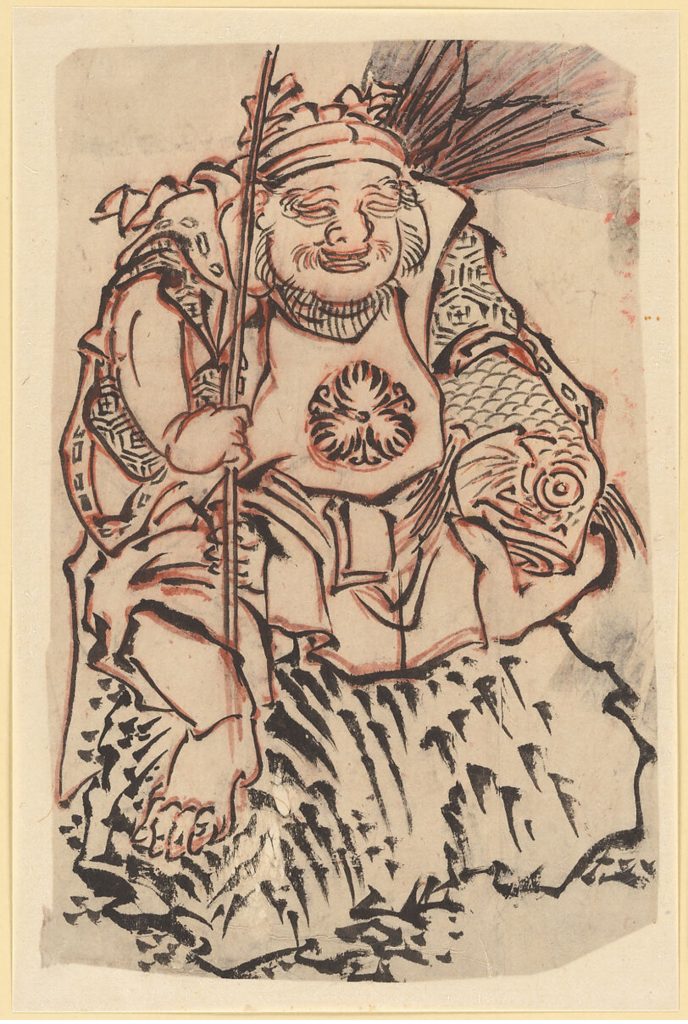
Image Description (English): An energetic ink and color drawing on paper, with bold black outlines accented by washes of red and vermilion, in the vigorous style of the Hokusai school. Ebisu, a round and joyful deity, grins broadly beneath a tall folded court hat (kazaori eboshi). He wears layered ceremonial robes decorated with geometric and circular patterns, and cradles an enormous sea bream — a symbol of abundance and celebration in Japan — under his left arm. Behind him, a fishing rod and what appear to be arrows rise above his shoulders. His entire posture radiates warmth, humor, and unshakable contentment. There is no trace of tragedy in this figure, no sign that he was ever cast away. This is the god that Hiruko became: not cured, not redeemed through usefulness, but simply taken in by a stranger on a shore — and transformed into one of the most beloved symbols of good fortune in Japanese culture.
Think about that for a second. The most “imperfect” child in Japanese mythology became the source of everyone else’s luck. Not by overcoming his disability. Not by being “cured.” Not through some inspirational training montage. He just washed up somewhere, was accepted by someone, and became who he was always going to be.
In the West, you have Hephaestus—the Greek god with a physical disability, thrown off Mount Olympus by his own mother, Hera, because he was ugly. He became the god of the forge, the master craftsman of all the gods’ weapons and treasures. But the other gods still mocked him. His wife, Aphrodite, cheated on him openly. His story is one of genius undercut by perpetual humiliation.
Hiruko got a different ending. He didn’t have to earn his place by being useful. He didn’t have to make weapons for the people who threw him away. He washed up on a shore, and a stranger said, “You’re here now. That’s enough.”
I think that’s the version of the story my son needed.
The uncomfortable truth about being a parent of a child with a disability is that you are, in some sense, always Izanagi and Izanami.
Not because you would ever put your child in a reed boat. But because society has already built the boat. The school system is a boat. The job market is a boat. The way strangers look at your kid on the train is a boat. And you—the parent—spend your entire life trying to pull your child out of boats that other people keep building.
But here’s what I couldn’t protect him from: the moment he realized the boat existed at all.
When my son read the Hiruko myth, he wasn’t reading a tragedy. He was reading his autobiography. He’d already felt the ocean. He’d already felt the reeds beneath him. He just hadn’t had a name for it until a 1,300-year-old book gave him one.
I went through a divorce. I know I loaded things onto my son’s small shoulders that I never meant to. I wanted to give him a life free of weight, and instead I handed him a suitcase full of it before he was old enough to know what luggage was.
So when I found out he’d been quietly identifying with a castaway god, the guilt was—how do I say this—architectural. It wasn’t a feeling. It was a building. It had floors.
But my son, it turns out, is smarter than his mother.
Because he didn’t stop at the part where Hiruko gets thrown away. He read to the end. He read the part where Hiruko becomes Ebisu. Where the broken child becomes the god people pray to when they need luck. Where the story flips, and the one who was discarded becomes the one everyone wants on their side.
He didn’t identify with a victim. He identified with a transformation.
I’m a journalist. I deal in facts, data, policy. I write about caregiver burnout rates and government budget allocations for disability services. I build arguments with statistics. But I cannot, with all my professional tools, construct anything as precise as what my son did when he looked at a myth and found himself in it—and chose the version where he wins.
Here’s the part I haven’t figured out yet.
I told myself that what I want is to be the shore. Not the parent who launches the boat, but the land he washes up on. A place that’s just there. That doesn’t chase him down but doesn’t disappear either. If he drifts toward me, I’m here. If he needs distance, the shore doesn’t move.
It sounds poetic. It sounds like good parenting. But honestly? It’s also the kind of thing you tell yourself when you’re terrified you’ve already done too much damage and “being still” is the only option that doesn’t risk making it worse.
The truth is, I don’t know if I’m the shore or just another piece of ocean. Motherhood doesn’t come with a map, and disability parenting doesn’t come with a compass. You just keep showing up and hope the current is kind.
But I do know this: somewhere in a 1,300-year-old book, a god was thrown away and became the luckiest thing in the room. And my son read that story and thought, “Yeah. That tracks.”
And if he can find himself in that myth and choose the ending where he’s Ebisu—grinning, holding a fish, surrounded by people who are glad he showed up—then maybe I can stop building boats in my head and just be the shore.
Maybe that’s enough.
A quick note for the non-Japanese readers: Ebisu is still everywhere. He’s on beer labels, in shopping districts, on good luck charms. Every January, there are Ebisu festivals across Japan where people pray for prosperity. Nobody at these festivals is thinking about the part where he was thrown away. They’re just happy he showed up.
I think there’s something in that for all of us. The world doesn’t need to know your origin story. It just needs you to show up, grinning, holding your fish.
My son already knows this. He’s been Ebisu this whole time. I was just too busy being Izanami to notice.
Back to Top of Page | Back to My Son’s Favorite God | Back to Volume 20, Issue 1 – Summer 2026
About the Author
Yu Taguchi is a welfare journalist based in Tokyo, Japan. The original story creator of the published manga, The World as Seen by Dementia (Takeshobo, 2023), she has contributed over 50 articles on disability, caregiving, and social welfare to major Japanese publications including Bunshun Online (文春オンライン), Nikkan SPA!, and Shueisha Online (集英社オンライン). She founded and served as editor-in-chief of “Aideal Hiroba,” a disability and minority-focused web platform that reached one million page views in its first year of operation. Yu Taguchi is the mother of a child with a disability. “My Son’s Favorite God Is the One His Parents Threw Away,” her first publication in English, is also published in Japanese—with thanks to the author—in this issue of Wordgathering.